
Restoring Balance: Inshore Fisheries, Social Justice and Local Governance in a Changing Environment
Presentation transcript from the Ocean and Coastal Futures Conference on 28th and 29th January 2026: By Emily Bulled and Rob Clark from the Association of Inshore Fisheries and Conservation Authorities.
Today I will be talking about nearshore recovery and restoration from the perspective of inshore and small-scale fisheries in England. Before I start, I just want to thank Rob Clark from the AIFCA for his contribution to this presentation and to Sarah Coulthard and the Inshore and Small-Scale Fisheries Consortium who’s work I will be referring to.
I wanted to begin by asking the audience a question. We talk about nearshore recovery and restoration as an environmental good, but for inshore fishing communities it can bring both opportunities and risks.
The question is – are we truly planning for both ecological and social futures? A future where governance is adaptive to our rapidly changing environment and healthy ecosystems sit alongside thriving coastal communities?
We know that England’s nearshore waters are home to some of our most productive and biodiverse habitats and support a variety of shellfish and finfish species. However, these habitats are not just abstract ecosystems, they are places of work. For centuries they have underpinned local economies that small-scale fisheries have relied upon but today these inshore fleets are facing many challenges leading to a significant reduction in the number of small boats. Both fisheries management measures and active restoration of habitats such as seagrass and oysters, directly affects where, when and how these communities can fish.
From our paper published by Coulthard et al. in Fish and Fisheries last year, it is the first time this rapid decline in the small-scale fleet has been mapped across the UK. This decline is important to recognise, because the loss of the fleet would have significant impacts to local economies, employment, and the heritage and social fabric of coastal towns, severely altering the nature and character of our coastline.
Through the work of the Inshore & Small-Scale Fisheries Consortium, we have been working to understand the causes of decline in the inshore and small-scale fleet. Long-term social, economic and environmental pressures such as rising operational costs, changing species distributions and an ageing fleet are just some examples. These are coupled with a lack of effective management outside 6nm and acute shocks such as market disruptions or adverse coastal health events which are having severe impacts on fisher livelihoods.
The AIFCA is working with the Coastal Health Livelihoods & Environment team at Cefas, who are working hard to prepare for adverse events of unknown origin in the marine environment, such as wash ups of commercial species, that are occurring more regularly around our coastline.
Small-scale boats are specifically vulnerable, making them less resilient to pressures and shocks. Boats are smaller, so fishing ranges are limited, especially as the weather becomes more volatile or as species distributions shift, they have fewer alternatives to adapt. Small-scale fisheries in England are also structurally disadvantaged. Most vessels are under 10 metres, yet they hold a very small proportion of quota. This forces reliance on non-quota species, and again, limits their ability to diversify. Small-scale boats are also more limited in their capacity to participate in decisions impacting their livelihoods, often due to working single-handedly with no land-based staff to support them.
Inshore fisheries in England are some of the best managed anywhere with overlapping spatial and gear restrictions. This is great for conservation, but for these fisheries to succeed, they rely on effective management outside of the inshore area. Small-scale fisheries in particular are often paying the price of good management, even though their fishing methods are relatively low impact.
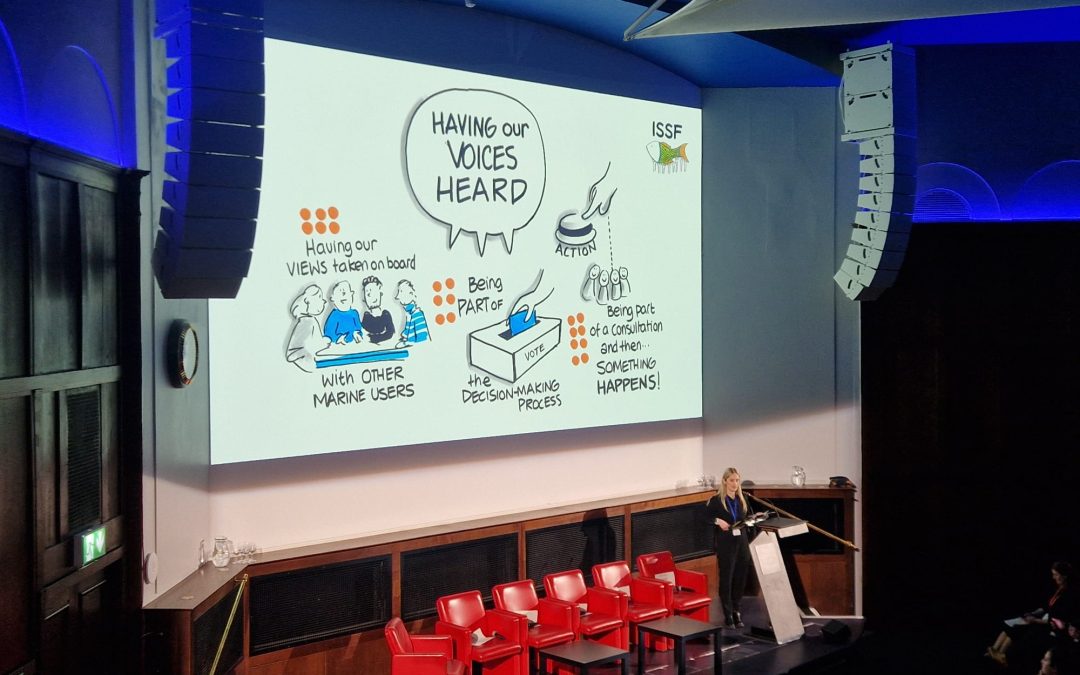
Through understanding these specific challenges and vulnerabilities from the fishermen themselves, the work of the ISSF Consortium has identified 7 priority opportunities to secure the inshore and small-scale fleet. Because this session is called Shared Stewardship, the priority opportunity I wanted to focus on is the need to involve these small-scale fishing communities, who are facing a number of pressures and vulnerable to change, in decision-making in a meaningful way.
To ensure we are planning for ecological futures with small-scale fisheries still present within it, decisions around fisheries management, or active restoration, must recognise the valuable local knowledge of inshore fishing communities, and consider social factors such as displacement, fishing dependency or safety.
For inclusion to be meaningful we must include elements of social justice. Social justice emphasises fairness and equity in the distribution of social, political, and economic resources. It seeks to ensure that all individuals, regardless of their background, have equal access to opportunities.
For meaningful participation to occur, communities need to be involved before decisions are fixed and participation must be resourced to allow a true process of co-design. The work of the ISSF Consortium consistently highlights the importance of meaningful participation.
The IFCA model also shows how meaningful participation works in practice. IFCAs have transformed the way that inshore fisheries at managed in England, for example, by ensuring all fishing activities are compatible with the conservation objectives of Marine Protected Areas. Decisions around IFCA byelaws are made by IFCA committees made up of elected members from the commercial, recreational and environmental sectors, as well as a range of experts, councils, scientists and community members who act objectively in the public interest. Wider stakeholders are also able to engage in the process through evidential, pre consultation and consultation phases. This ensures that decisions balance the needs of the marine environment and sustainable fisheries.
When we think about planning for ecological and social futures, we need to ensure we are set up for the long-term. With the inevitable shifts in species distributions, IFCAs are preparing by introducing governance structures that are adaptive. Flexible permit byelaws allow quicker changes in management with new evidence and data, avoiding having to go through the whole process of a completely new byelaw when changes occur.
IFCA byelaws, and their long-term monitoring frameworks and enforcement practices ensure outcomes are institutionally sustainable. Restoration projects need to be integrated into institutional sustainability, to ensure that projects endure beyond funding cycles and the value does not flow out of local communities once the projects are complete.
At a conference named after the future of our coast, we need to look beyond historical baselines and have the foresight to plan for new environments and fisheries. Climate change is already reshaping nearshore species composition. Pacific oysters and Manila clams are likely to become increasingly abundant and economically important.
So we need to ask ourselves – what legacy do we want?
If we are going to have a future with restored ecosystems and thriving coastal communities, governance must be:
- adaptive to changes,
- institutionally sustainable,
- and decisions need to recognise local knowledge
- and consider inshore and small-scale fisheries in a meaningful way
IFCAs show what this can look like, but only if they are properly resourced, and included in future planning. We welcome further meaningful engagement in how our coastal fisheries are managed. I also want to thank everyone in this room and partners of AIFCA for all their hard work in supporting coastal fisheries.
Thank you so much for your time and please watch our new films that are now released on how IFCAs lead, champion and manage a sustainable marine environment and inshore fisheries.